
The Strait of Hormuz, situated between Iran to the north and Oman to the south, serves as the narrow maritime passage connecting the Persian Gulf to the Gulf of Oman and the broader Arabian Sea. This strategically vital waterway is the world’s most important oil transit chokepoint, as it accommodates the flow of approximately 20 million barrels of oil per day, equivalent to roughly one-fifth of global petroleum liquids consumption, along with substantial volumes of liquefied natural gas. Its depth and width enable passage of the largest crude oil tankers, yet its constricted shipping lanes leave few viable alternative routes for Gulf oil exports, making any disruption potentially severe for global energy supplies.
SOURCE: EIA.GOV
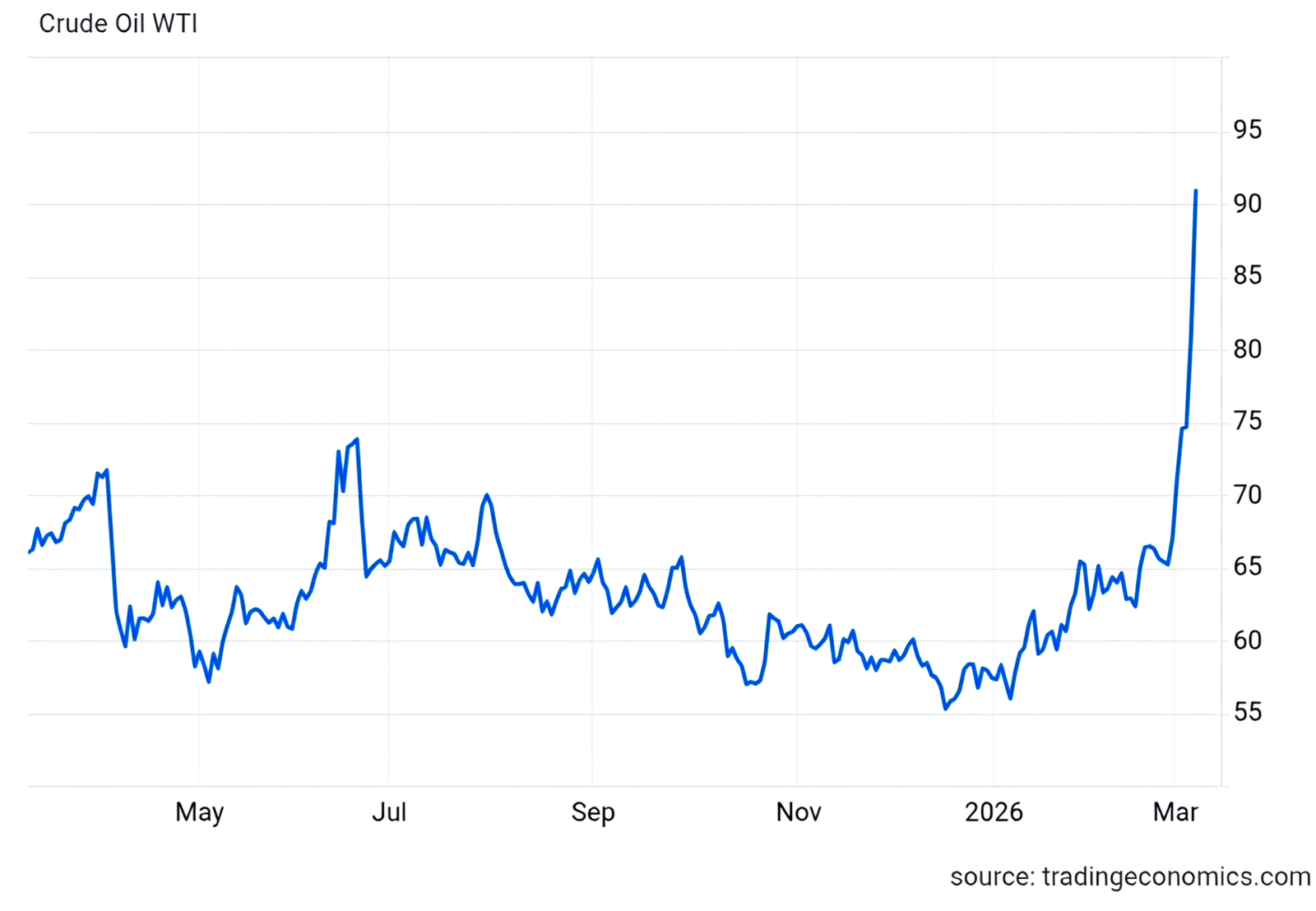
Brent crude oil surged to $91 per barrel on Friday, March 6, with futures settling at $92.69 per barrel, up 8.52% on the day. West Texas Intermediate (WTI) crude closed at $90.90 per barrel, up 12.21%. This marked Brent’s largest weekly gain since April 2020, with a roughly 25–28% increase over the week, while WTI recorded its biggest weekly gain in futures trading history dating back to 1985, at approximately 35%.
The price surge stems from the escalating conflict involving the United States, Israel, and Iran, now in its second week, with the effective closure of the Strait of Hormuz halting nearly all tanker traffic. The strait carries about 20% of global oil supply and significant liquefied natural gas flows.

Iraq and Kuwait face potential supply losses of up to 4.7 million barrels per day if the closure persists. Qatar’s energy minister warned that prolonged conflict could push oil prices to $150 per barrel.
Global energy markets show no immediate resolution, with shipping stranded and supply losses estimated at 7–11 million barrels per day.
SOURCE: Yahoo Finance & Watcher.Guru

